Astra's First Version vs. My Designer-Directed Jelly Gem
The changes that took Jelly Gem from its first playable version to the game I had in mind: branding, color, texture, composition, and movement.
Here's part 2 of my development journal, following the first post!
Read part 1: Making a Game with AI: What I Did as the Designer
Drop, bounce and merge luminous little jellies into a heart.
What I learned this time
If you can't get the whole scene you want in one go, you can generate the elements separately with AI and put them together yourself.
For me, generating each element individually and then adjusting the colors, textures, and composition in Photoshop was the fastest way to get to something that suited my taste.
How far did the first version get?
As I mentioned in part 1, the basic gameplay really did come together in a single attempt. It was amazing to see an actual working game where you could drop pieces and merge matching ones.
But the first playable version felt quite different from Jelly Gem as it is now.
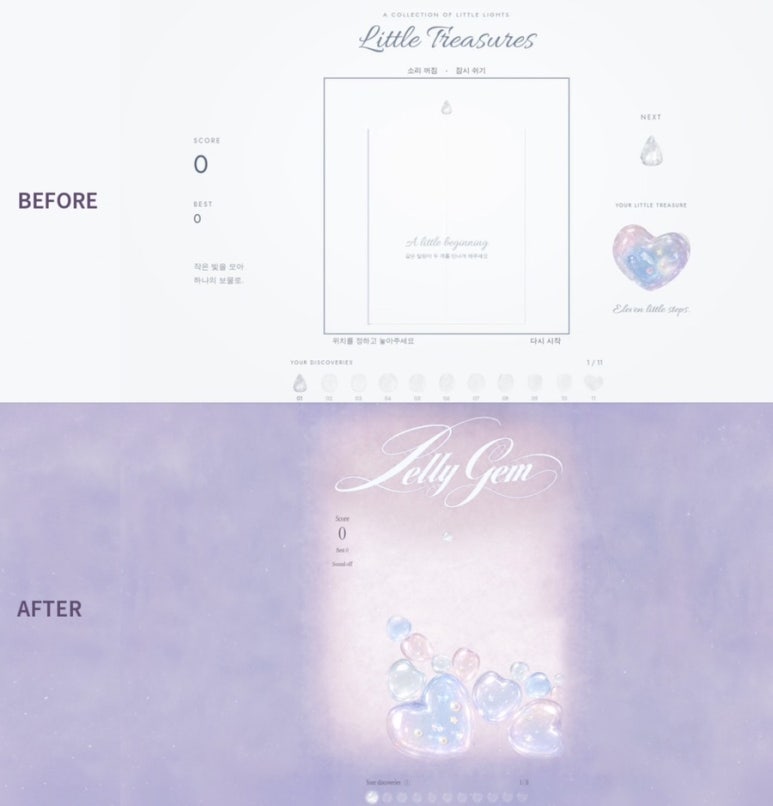
Before: Astra's first version. After: the version shaped by my direction.
What I want to compare here is the first version you could actually play, rather than a beautiful game mockup generated by AI. The initial image mockup looked much prettier, but when I tried the playable version, this was what it looked like. An image of a proposed design and a game you can actually click and play turned out to be quite different things.
What did I change, and how?
The atmosphere I wanted was in my head, so first I had to communicate it: the overall colors, how translucent the squishies should look, and how much sparkle they should have inside.
It would be lovely if “make it pretty in a way I'll like” were enough. But first I had to explain what I liked, so we talked through references together.
There were three main changes.
First, the name and logo. I changed the name from “Little Treasure” to “Jelly Gem” and redesigned the logo to match. The brand design work I usually do found its way into this project, too.
Second, the colors, textures, and overall visual style. The first version wasn't bad, but I wanted more of the feeling I personally like. Even with the same game, the colors and textures can make it feel very different.
Third, removing unnecessary elements. I took out small bits of explanatory text and lines from the first screen. I kept the information needed to play, while making it easier to focus on dropping and merging the squishies. I spent as much time taking things away as adding them.
How did I make the background?
I generated every element separately in ChatGPT, including the texture images and typography. Then I brought them into Photoshop and combined them, adjusting the colors, textures, and arrangement to finish the background I wanted.
I didn't ask for a finished background in one go. I generated the pieces individually and put them together myself.
For this part, working on it directly was still the fastest option. I knew the mood I wanted, so I adjusted it visually in Photoshop, then handed over the finished image and asked for it to be applied to the game.
Could I make changes without writing code?
I asked Astra to handle the code changes, too.
What I described was what I wanted to see change in the result: a bigger difference in size between two levels, smaller pieces inside a jelly, or a little compression when the jellies bumped into each other.
AI handled how to change the code, and I played the game again to check whether it looked the way I wanted. I wasn't directing the work from a deep understanding of development. It really was vibe coding.
If I'd stopped after the first version, it would have been quite different from the Jelly Gem I imagined. Once the basic gameplay was in place, I kept working on the colors, images, and movement.
I'll also keep steadily sharing my future work on Instagram!
Originally published in Korean on September 28, 2026. English translation prepared October 1, 2026. Read the original on Naver.